Craft
What Makes Chiniot Furniture Different from Everything Else
Four hundred years of carving tradition, the three techniques that define it, and how to recognise genuine Chinioti work in a market full of machine-cut imitations.
By Chiniot Furniture Galleria · · 3 min read
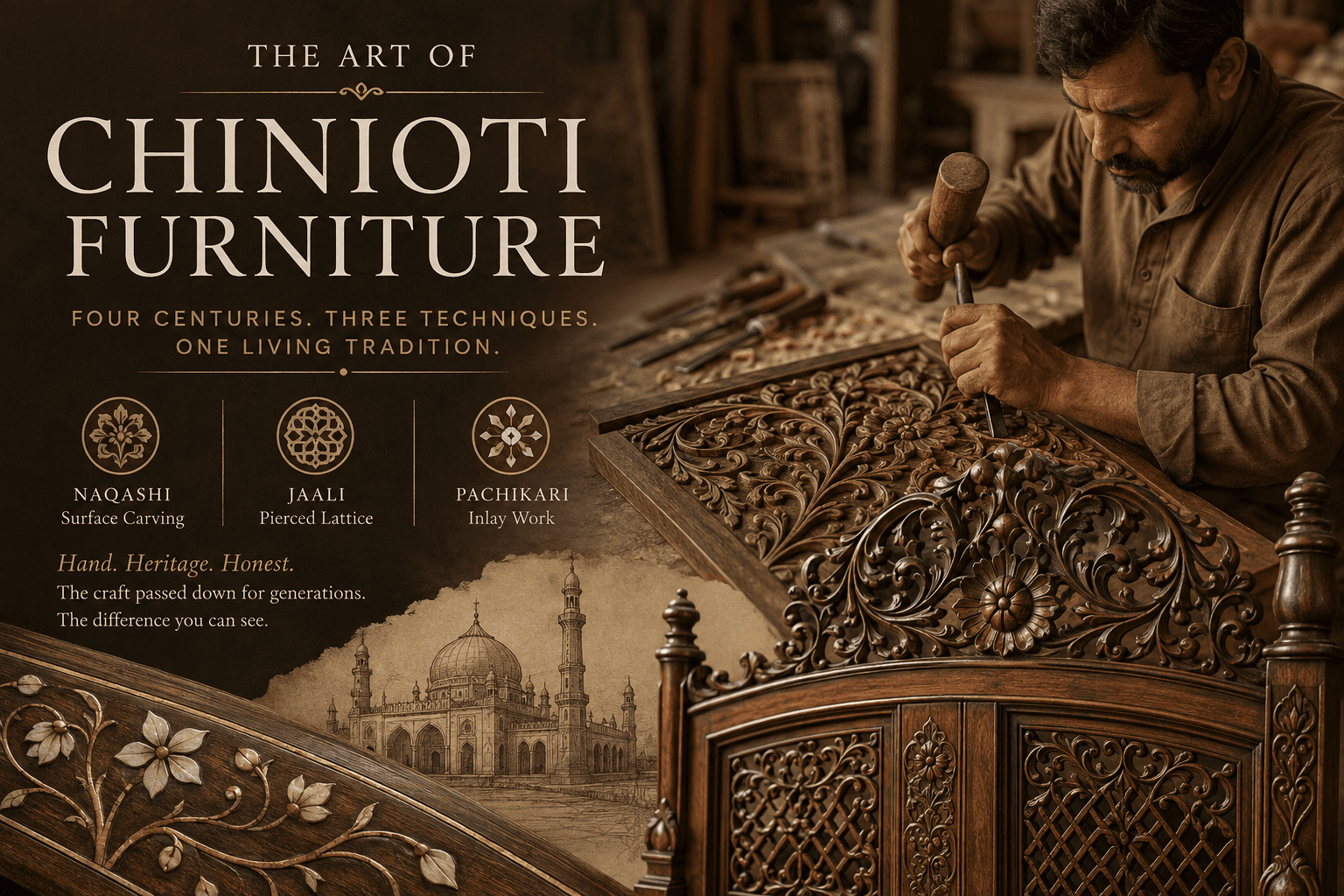
Chiniot is a small city on the Chenab whose name has been a furniture guarantee for four centuries. The craft began with mosque and shrine joinery — the woodwork of the city’s great buildings came out of the same workshops — and passed down as a family trade, from carver to son, chisel by chisel. That lineage is the actual product.
The three techniques
Naqashi, surface carving
Floral vines, geometric repeats and arabesque panels cut in relief into the face of solid timber. A carver scores the outline, then removes material in dozens of shallow passes so the grain never tears. The depth is decided by the wood, not by the drawing — which is why hand-carved repeats are never quite identical, and machine-cut ones always are.
Jaali, pierced lattice
The screen work you see in a headboard, a cabinet door or a swing back, cut freehand right through the panel with no template and no CNC pass. Jaali is the hardest thing to fake cheaply, because a router leaves a uniform vertical wall on every cut and a chisel does not.
Pachikari, inlay
Brass wire and bone or shell set into channels cut by hand and hammered flush. Done properly the inlay sits perfectly level with the surface and stays there for decades; done quickly it stands proud, catches on cloth and lifts within a year.
Why it takes so long
A carved Chinioti bed headboard is close to three weeks of one carver’s work. A seven-seater classical sofa set with carved show-wood on every frame can occupy a workshop for a month and a half. Add timber seasoning — Sheesham is kiln-dried to 8 to 12 percent moisture before a chisel touches it — and the honest lead time on a made-to-order piece is measured in weeks, not days.
Anything sold as hand-carved Chinioti, available for immediate delivery, at a low price, is almost certainly router-cut on MDF or mango and finished to look the part.
How to recognise genuine Chinioti work
- Look for variation. Compare two repeats of the same motif on one panel. Hand-carving varies
slightly in depth and line. Machine work is identical to the millimetre.
- Look inside the cuts. A chisel leaves faceted, slightly irregular walls. A router leaves a
smooth uniform wall and a small radius at every internal corner, because a spinning bit cannot cut a sharp inside angle.
- Turn the piece over. Traditional work is honest underneath — visible mortise-and-tenon
joints, no cam locks, no stapled panels.
- Weigh it. Solid Sheesham is heavy. Ornament on a light frame is ornament on something else.
- Ask where it was made. A real answer names a workshop and a family, not a city.
A carver in Chiniot will tell you the wood decides the depth. You follow it. That sentence is the entire difference between the craft and its imitation.
What we do with it
We have bought from the same Chiniot workshops for two generations. Every piece in the classical collection is carved by hand in kiln-seasoned solid Sheesham, joined with mortise and tenon, and finished with a hand-rubbed polish that darkens gently with age rather than sitting on the wood as a film.
Because everything is made to order, the carving on your piece is cut for your piece. That is not a marketing line — it is simply how the craft works when nobody has installed a CNC machine.
Frequently asked
- What is Chiniot furniture?
- Chiniot furniture is hand-carved solid wood furniture made in Chiniot, Punjab, using a four-hundred-year-old tradition of naqashi surface carving, jaali pierced lattice and pachikari brass and bone inlay, almost always in solid Sheesham.
- How can I tell hand-carved furniture from machine-carved?
- Compare two repeats of the same motif — hand-carving varies slightly in depth and line while machine work is identical. Inside the cuts, a chisel leaves faceted irregular walls and sharp internal corners; a router leaves smooth uniform walls with a small radius at every inside angle.
- How long does hand-carved Chinioti furniture take to make?
- A carved bed headboard is roughly three weeks of one carver’s work, and a large classical sofa set can occupy a workshop for six weeks, on top of kiln-seasoning the timber. Genuine made-to-order pieces are quoted in weeks.
Keep reading

Wooden Bed Designs: Chinioti, Italian, Modern and Classical Styles Explained
Wooden bed designs for Pakistani bedrooms — carved Chinioti, classical, Italian upholstered, wingback, platform and modern — with bed sizes, headboard heights and how to choose.

Furniture as a Wedding Gift: 10 Pieces That Are Actually Used
Ten wooden furniture wedding gift ideas for a couple, from Rs 38,000 table lamps to swings and dining sets — plus how to choose a piece that fits their home and style.
How to Order Custom Furniture in Pakistan: From Measurements to Delivery
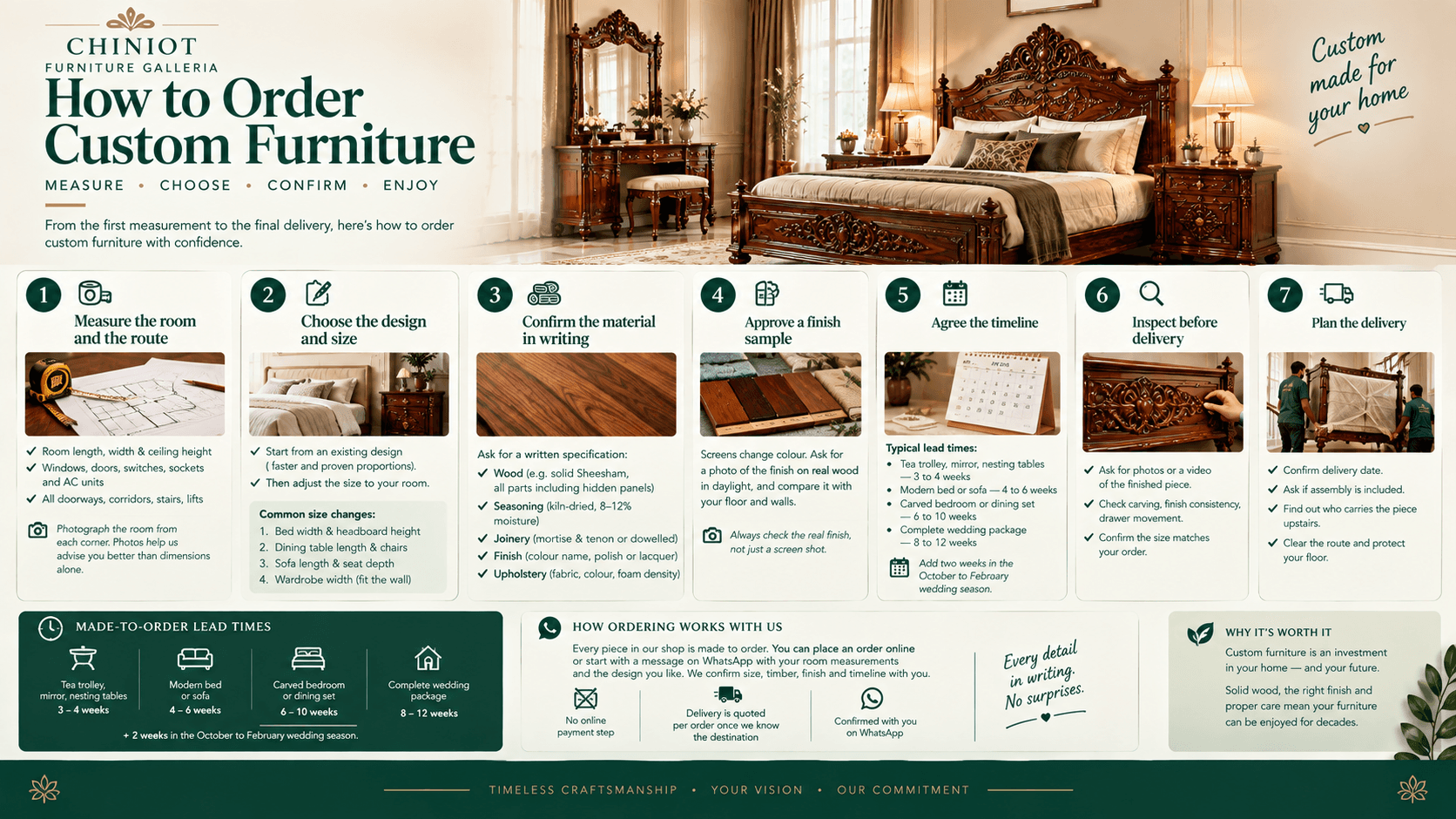
A step-by-step guide to ordering made-to-order furniture — measuring, choosing wood and finish, approving the design, lead times, payment milestones, inspection and delivery.